
Ayurveda: The Art of Living in Harmony with Nature


This morning, as I sat quietly with a cup of hot coffee, I felt the cool autumn air brushing against my skin. The shift in temperature, the change in light, and even the subtle difference in my energy reminded me of how deeply our bodies are connected to the rhythms of nature. This awareness brought me back to the wisdom of Ayurveda — the ancient science that teaches us how to live in harmony with these natural cycles, within and without.
What Is Ayurveda?
The word Ayurveda comes from Sanskrit — Ayus meaning “life,” and Veda meaning “knowledge” or “science.” Together, it translates as “the science of life.”
More than 5,000 years old, Ayurveda is a holistic system of healing that views each human being as a unique combination of energy, matter, and consciousness. It doesn’t treat symptoms in isolation but instead looks at the whole person — body, mind, and soul — in continuous interaction with the environment.
Ayurveda provides the holistic map of how energy, matter, and consciousness express through our being. It’s the physical and energetic foundation of yoga philosophy — a way to understand the body as a sacred vessel for spiritual evolution.
The Five Great Elements (Pancha Mahabhutas)
At the heart of Ayurveda lies the concept of the five great elements, or Pancha Mahabhutas. These elements form the foundation of all creation — from the galaxies to our cells.
Element | Sanskrit Name | Qualities | In the Body |
Earth | Prithvi | Stability, solidity, structure | Bones, muscles, tissues |
Water | Jala | Flow, cohesion, lubrication | Blood, lymph, saliva |
Fire | Agni | Transformation, heat, digestion | Metabolism, vision, intellect |
Air | Vayu | Movement, motion, breath | Circulation, respiration, nervous system |
Ether (Space) | Akasha | Expansion, openness, vibration | Sound, mental clarity, consciousness |
Each of us contains all five elements in varying proportions. The balance of these elements determines our physical constitution, emotional tendencies, and even how we respond to the world around us.

The Three Doshas: Vata, Pitta, and Kapha
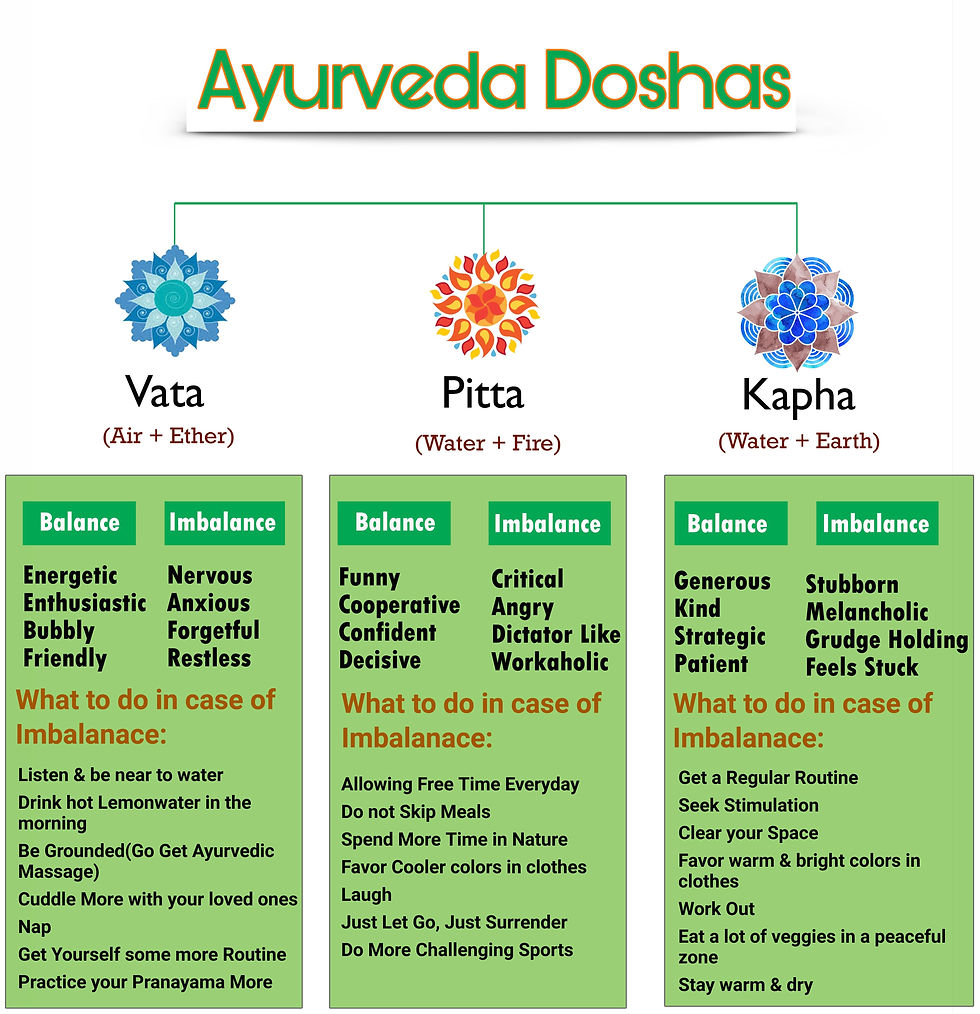
Ayurveda groups these elemental combinations into three doshas, or biological energies:
Dosha | Elements | Qualities | Governs | Balanced State | Imbalanced State |
Vata | Air + Ether | Light, dry, cold, mobile | Movement, breath, creativity | Inspiration, adaptability | Anxiety, restlessness, dryness |
Pitta | Fire + Water | Hot, sharp, intense, oily | Digestion, transformation, vision | Focus, courage, leadership | Anger, irritation, inflammation |
Kapha | Earth + Water | Heavy, cool, stable, moist | Structure, immunity, love | Calmness, compassion, endurance | Lethargy, attachment, congestion |
Each person has a unique balance of these doshas, known as their prakriti (natural constitution). When these energies are balanced, we feel vibrant, focused, and at peace. When they are disturbed — by stress, diet, weather, or lifestyle — we experience dis-ease in body and mind.
By recognizing our dominant dosha and making conscious adjustments, we can live more in tune with our natural rhythm.
Daily Rhythms and Harmony (Dinacharya)
Ayurveda emphasizes that true wellness comes from daily habits (dinacharya) that align with nature’s cycles — sunrise, sunset, seasons, and even the phases of the moon. These rituals anchor our body and mind in balance and clarity.
Simple Ayurvedic daily habits:
Wake before sunrise to synchronize with the rising prana of nature.
Cleanse the senses — tongue scraping, oil pulling, and washing the eyes with cool water.
Practice yoga and pranayama to awaken and balance prana.
Eat mindfully, with gratitude and awareness of your dosha.
Wind down before sleep with calming rituals — warm milk with turmeric, light reading, or meditation.
These simple rhythms help the doshas stay in balance and allow Agni, the inner fire of digestion and perception, to function smoothly — physically, mentally, and spiritually.
Ayurveda and Yoga: One Path, Two Expressions
While yoga offers the path of self-realization through awareness and union, Ayurveda offers the way to maintain the vessel — the body and mind — through balance and harmony. Together, they remind us that our health, emotions, and spiritual development are not separate journeys but one continuous expression of divine energy moving through form.
Closing Reflection
As I finish writing this, I’m reminded of how even the simplest moments — sipping warm tea, feeling the sunlight, or breathing deeply — are opportunities to live Ayurvedically. Every choice we make either nourishes or depletes our life force.
When we choose to live with awareness of nature’s rhythm, we return to balance.
Ayurveda teaches us that healing isn’t about adding more, but about remembering our natural state — where body, mind, and soul exist in perfect harmony with the universe.
“When diet is wrong, medicine is of no use. When diet is correct, medicine is of no need.”— Ayurvedic Proverb


Comments